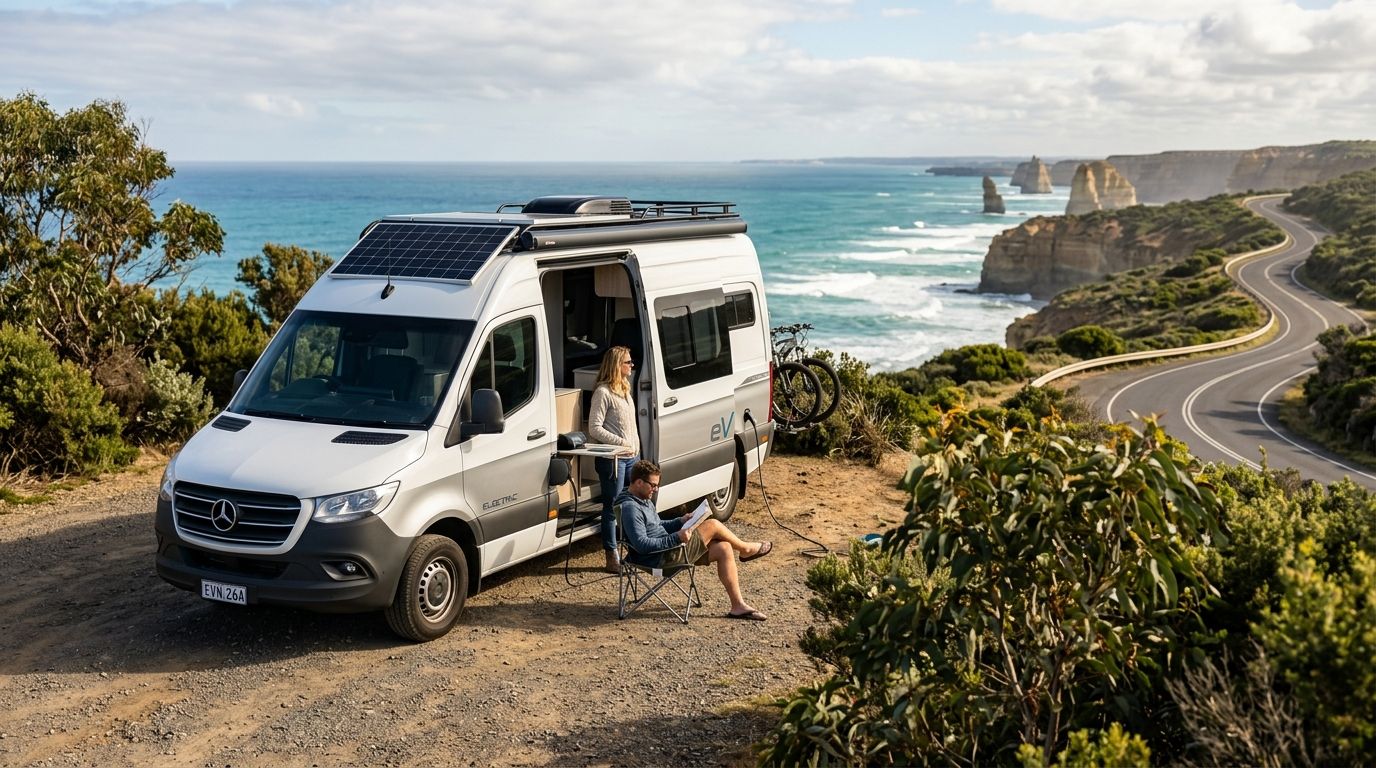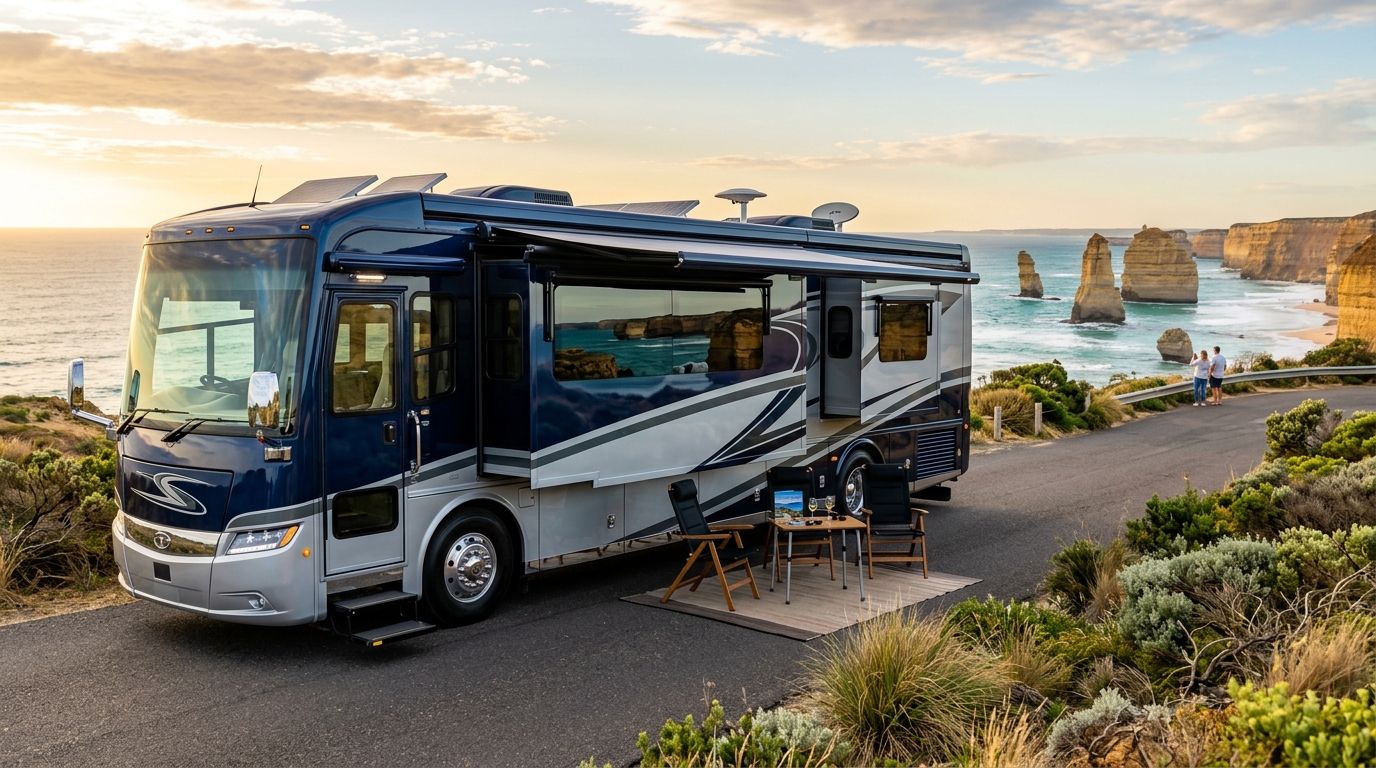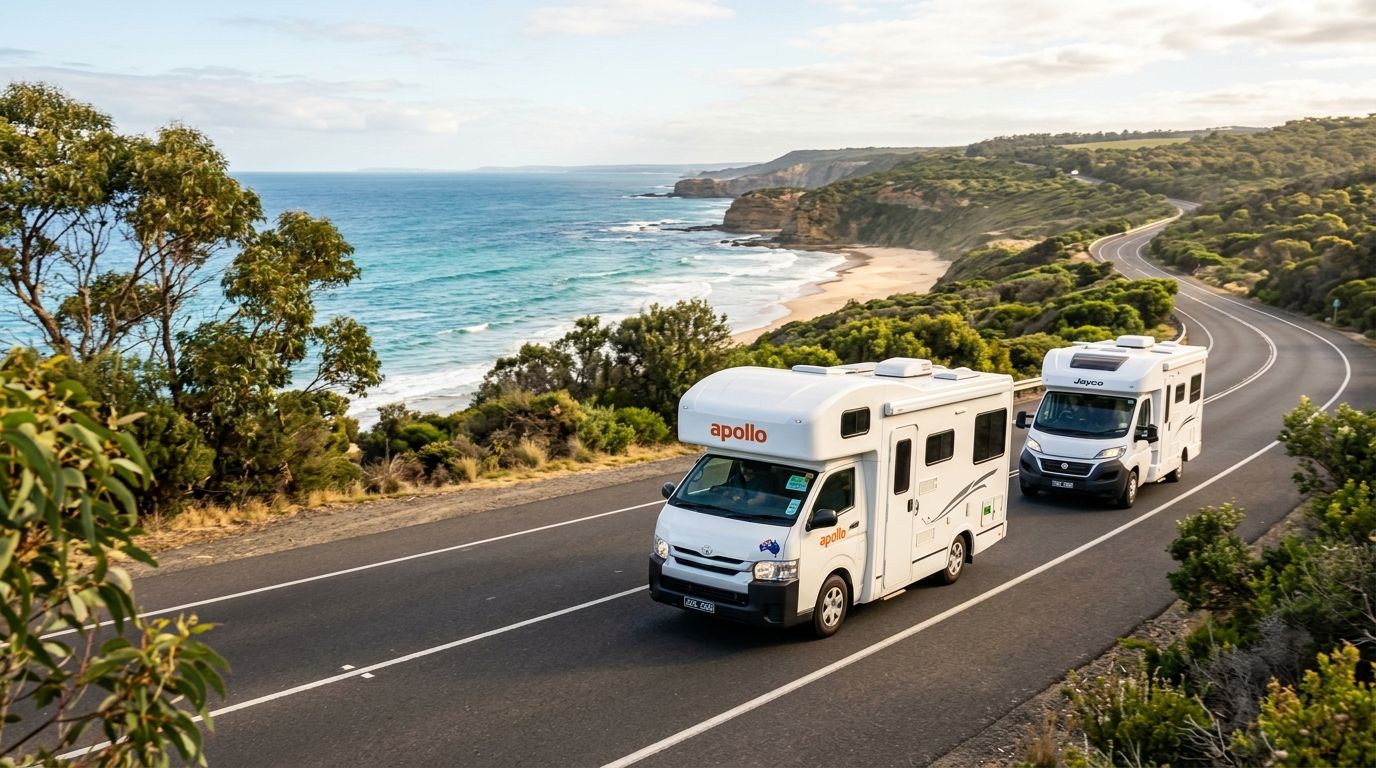
This guide ranks Australian motorhomes by fuel efficiency for 2026, covering Latitude Motorhomes' Element 27, Meridian 30 and ibeX 4x4 alongside compact luxury campervans and pre-owned Iveco Daily builds.
Best overall for balanced fuel use: the Latitude Element 27. Best for full-time living despite higher fuel draw: the Latitude Meridian 30. Best for off-road touring: the Latitude ibeX 4x4. Best for the lightest footprint: a compact luxury campervan. Best budget-efficient pick: a pre-owned Iveco Daily motorhome.
- The Latitude Element 27 balances cabin space and fuel use best among Iveco Daily 70C motorhomes in 2026.
- 4x4 models like the ibeX trade fuel efficiency for ground clearance and off-road traction.
- Compact luxury campervans post the lowest fuel draw of any layout in this ranking.
- Pre-owned Iveco Daily motorhomes give buyers proven fuel behaviour without a new-build wait.
- Weight, wheelbase and tyre choice affect motorhome fuel efficiency more than badge or brand.
Why this matters
Fuel is one of the few running costs a motorhome buyer controls in 2026 before they ever sign a contract. Body length, weight and drivetrain decide how much diesel a motorhome burns on the same stretch of highway, long before driving style even enters the picture.
Every model built at Latitude Motorhomes' Burleigh Heads factory, including the Element 27, sits on the same Iveco Daily 70C cab-chassis platform. That shared base is exactly why the differences in fuel efficiency across this ranking come down to body, weight and drivetrain choices, not the underlying chassis.
What makes the best fuel-efficient motorhome
- Chassis weight and GVM class -- heavier builds need more diesel to move the same distance
- Body length and frontal area -- longer, taller bodies push more air and burn more fuel at highway speed
- Drivetrain: 2WD vs 4x4 -- 4x4 gearing and off-road tyres add rolling resistance
- Wheelbase and payload management -- an overloaded motorhome burns more fuel regardless of model
- Fuel tank capacity vs range needs -- efficiency and range aren't the same measurement
- Driving style and speed -- highway speed matters more to diesel use than most buyers expect
Motorhomes ranked by fuel efficiency: at a glance
| Motorhome | Best for | Standout feature | Key limitation |
|---|---|---|---|
| Latitude Element 27 | Balanced fuel use for touring couples | Mid-size body on the Iveco Daily 70C chassis | Less cabin space than the Meridian 30 |
| Latitude Meridian 30 | Full-time living | Largest floor plan in the Latitude range | Extra body length and weight cut into fuel economy |
| Latitude ibeX 4x4 | Off-road and outback touring | 4x4 drivetrain with ground clearance | Off-road tyres and low-range gearing use more fuel |
| Compact luxury campervan | Lightest footprint touring | Smallest body and lowest weight class | Less living space for long stays |
| Pre-owned Iveco Daily motorhome | Value-focused efficiency | Proven fuel and service history | Older units may need tyre or service work |
1. Latitude Element 27: best motorhome for balanced fuel efficiency
Heading into 2026, the Element 27 sits in the middle of the Latitude range on both floor plan and body length, and that middle position is exactly why it ranks first here. Built on the Iveco Daily 70C chassis at the Burleigh Heads factory, it carries enough cabin for a couple to live aboard without the extra body length and weight the Meridian 30 needs for full-time living.
Element 27 pros:
- Mid-size body keeps frontal area and weight lower than the Meridian 30
- Built on the Iveco Daily 70C cab-chassis platform, purpose-built for motorhome conversions
- Factory-built at Burleigh Heads with the model line handled in-house, start to finish
Element 27 cons:
- Compact luxury campervans still beat it on raw fuel use
- Standard 2WD gearing isn't built for outback off-road runs like the ibeX 4x4
- Cabin space is a step down from the Meridian 30 for full-time living
Best for: couples and short-to-medium-term travellers who want a fuel-conscious daily driver without giving up motorhome-grade comfort.
Verdict: Buy.
2. Latitude Meridian 30: best motorhome for full-time living
The Meridian 30 is Latitude's largest model, built for buyers who live aboard for months rather than weekends. More floor plan means more body length and weight on the same Iveco Daily 70C platform, and that extra mass is the direct trade-off for the extra room.
Meridian 30 pros:
- Largest floor plan in the Latitude range, built for full-time living
- Same Iveco Daily 70C chassis and Burleigh Heads build quality as the Element 27
- More onboard storage for long-haul touring without restocking often
Meridian 30 cons:
- Larger body and higher weight class use more fuel per kilometre than the Element 27
- Longer wheelbase makes tight touring routes harder to manage than the smaller models
- Not the pick if fuel economy outranks living space on your list
Best for: full-time travellers who value space over fuel savings.
Verdict: Buy if full-time living is the goal; Skip if fuel economy is the only priority.
3. Latitude ibeX 4x4: best motorhome for off-road touring
The ibeX 4x4 is the only model in the Latitude range built for genuine off-road access, and its 4x4 drivetrain is also why it ranks lower here on efficiency. Four-wheel drive gearing, off-road tyres and added running gear all add rolling resistance and weight that a 2WD motorhome simply doesn't carry.
ibeX 4x4 pros:
- 4x4 drivetrain and ground clearance built for outback and unsealed-road touring
- Reaches camping spots the Element 27 and Meridian 30 can't get near
- Iveco Daily 70C base shared across the range for consistent service support
ibeX 4x4 cons:
- 4x4 gearing and off-road tyres increase fuel use compared with the 2WD models
- Not the right pick if most of your touring stays on sealed highway
- Higher running weight than the Element 27
Best for: buyers who tour unsealed outback routes where ground clearance matters more than fuel economy.
Verdict: Buy for off-road touring; Hold if you mostly drive sealed roads.
4. Compact luxury campervans: best for the lightest footprint
Below the full motorhome layouts, compact luxury campervans post the lowest fuel draw of any option in this ranking. Less body length, less weight and a smaller frontal area all cut fuel use directly -- the same physics that makes a small car more efficient than a 4WD applies to campervans versus large motorhomes.
Compact campervan pros:
- Lowest weight and smallest frontal area of any layout on this list
- Easier to park and drive day-to-day than a full-size motorhome
- Lower fuel use over long touring distances
Compact campervan cons:
- Less living space for long stays or full-time living
- Fewer onboard amenities than the Element 27 or Meridian 30
- Not built for genuine off-road access like the ibeX 4x4
Best for: solo travellers and couples prioritising fuel economy and easy driving over cabin space. See the full luxury campervan lineup for layout options.
Verdict: Buy for short-haul, fuel-conscious touring.
5. Pre-owned Iveco Daily motorhomes: best budget-efficient option
Buying pre-owned doesn't change the physics of fuel economy, but it does let a buyer get into a proven Iveco Daily 70C build faster than ordering new. A motorhome with real service history on the clock also gives a clearer read on actual fuel behaviour than estimates on a brand-new build.
Pre-owned pros:
- Proven fuel and maintenance history instead of new-build estimates
- Same Iveco Daily 70C chassis engineering as current Latitude models
- A practical way into the Element 27, Meridian 30 or ibeX 4x4 platform sooner
Pre-owned cons:
- Older units may need tyre or service work that affects real-world fuel use
- Fewer of the latest chassis or drivetrain updates than a new build
- Fewer configuration choices than ordering a new build
Best for: buyers who want proven fuel behaviour on the Iveco Daily 70C platform without ordering new.
Verdict: Buy if the service history checks out; Hold if it doesn't.
How we ranked
The 2026 ranking runs on four factors: chassis weight class, body length and frontal area, drivetrain type, and tyre choice. Lighter, shorter, 2WD builds rank higher for fuel efficiency; heavier, longer, 4x4 builds rank lower even when they win on capability or space. The Element 27's middle-of-the-range size on the Iveco Daily 70C chassis is what puts it ahead of the larger Meridian 30 and the 4x4-equipped ibeX.
“The heaviest motorhome you can buy is rarely the most fuel-efficient one you will actually drive every day.”
Book a factory visit
See the Element 27, Meridian 30 and ibeX 4x4 in build at Burleigh Heads.
Which motorhome should you choose?
If you're undecided, start with the trade-off you're least willing to make. Pick the Latitude Element 27 if fuel economy and comfort both matter and you don't need full-time living space. Pick the Meridian 30 if you're moving aboard for months at a time and space outranks the fuel bill. Pick the ibeX 4x4 if outback access is the point of buying a motorhome at all. A compact campervan wins on fuel use alone, and a pre-owned Iveco Daily build wins on getting into a proven platform sooner.
FAQ
What's the most fuel-efficient motorhome in Australia?
Among Iveco Daily 70C-based motorhomes in 2026, mid-size builds like the Latitude Element 27 generally use less fuel than larger or 4x4 models because of lower weight and a smaller frontal area. Compact luxury campervans use even less fuel due to their smaller size, though they trade off living space.
Are 4x4 motorhomes less fuel efficient than 2WD models?
Yes -- 4x4 drivetrains, off-road tyres and low-range gearing add weight and rolling resistance that increase fuel use compared with a 2WD motorhome on the same chassis. The Latitude ibeX 4x4 trades some fuel efficiency for outback access the 2WD models don't have.
Does a heavier motorhome always use more fuel?
Generally yes -- more weight and a larger frontal area both increase the diesel needed to maintain highway speed. This is why the larger Meridian 30 uses more fuel per kilometre than the mid-size Element 27 on the same Iveco Daily 70C chassis.
Is a campervan more fuel-efficient than a full-size motorhome?
Yes -- a compact luxury campervan has less body length, less weight and a smaller frontal area than a full-size motorhome, all of which reduce fuel use. The trade-off is less onboard living space for long stays.
How does chassis choice affect motorhome fuel economy?
The chassis sets the baseline weight class and drivetrain options a motorhome builder works with. Latitude Motorhomes builds its Element 27, Meridian 30 and ibeX 4x4 on the same Iveco Daily 70C platform, so fuel differences across those models come from body and drivetrain choices, not the chassis itself.
Should I buy pre-owned for better fuel economy?
A pre-owned Iveco Daily motorhome won't be more fuel-efficient than the same model new, but it does come with real service history that shows actual fuel behaviour instead of estimates. That makes it a practical entry point if fuel predictability matters more than buying new.
Does driving speed change motorhome fuel consumption significantly?
Yes -- wind resistance increases sharply at highway speed, and a tall, boxy motorhome body pushes more air than a car or campervan at the same speed. Slowing down on long touring stretches is one of the few fuel-saving levers a driver controls regardless of model.
One last thing
The single biggest lever on motorhome fuel use isn't the model you buy -- it's how you load and run it. Check payload and tyre pressure before blaming the chassis for a bad fuel run heading into the 2026 touring season; an overloaded motorhome on underinflated tyres burns more fuel than the gap between a 2WD and a 4x4 model of the same size.